I have been building for the web for more than 30 years. In that time I have shipped more than 50 platforms, written a book on responsive design for Packt, and spent ten years explaining technology on a nationally syndicated radio and TV show.
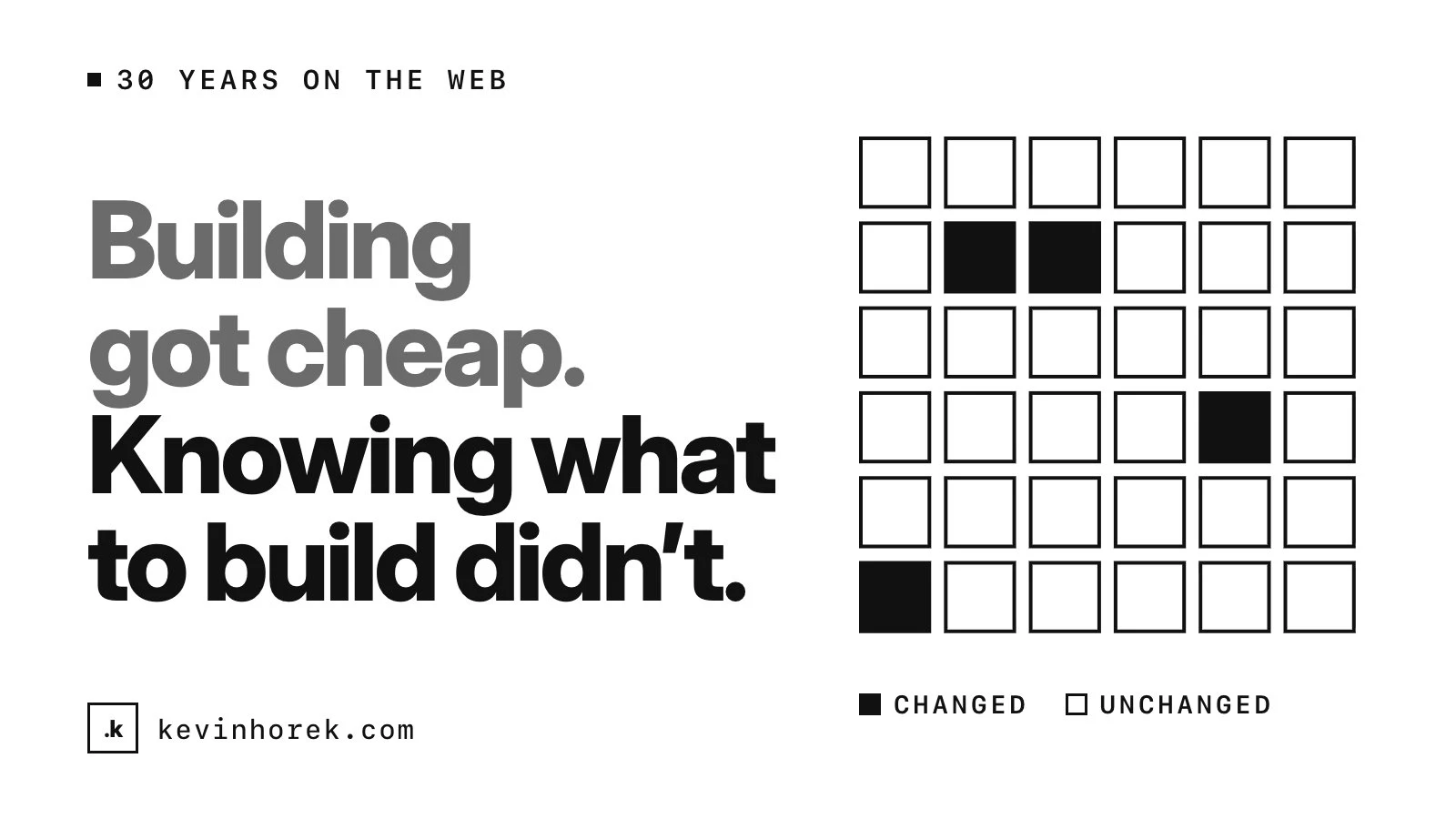
Every few years someone announces that everything has changed. Usually a few things have changed and most things have not. AI is the biggest shift I have seen, and that pattern still holds.
What changed
Building got dramatically faster
The most obvious change is speed. I now work with the latest models from Anthropic, OpenAI and Google for research, specs, design and code, picking the model for each task. A well-scoped v1 that once needed a team for months can now be designed and built by one senior person in weeks, with a working preview every few days.
That is not a small improvement. It changes who can build a product, how early you can test an idea, and how much a mistake costs.
The spec matters more, not less
When code is cheap to write, the expensive part becomes deciding what to write. I spend more time than ever on discovery calls, walk-throughs and a detailed, sourced spec before any building starts. AI turns a good spec into working software quickly. It turns a vague spec into the wrong software just as quickly.
Products can do new things
AI also changed what products can do: reading a pitch transcript and ranking the mentors who fit, summarizing an article before you open it, grouping hundreds of screenshots into a handful of meaningful changes. Products like Mentor Intelligence, BlastRocket and R3ader would have been far harder for one person to build a few years ago.
What did not change
People still need to understand the problem
No model can tell you what your users actually need. You still have to talk to them, watch them work and notice the spreadsheet they keep open beside your product. Discovery is as human as it ever was.
Testing with real users still decides
AI can generate a dozen versions of a screen. It cannot tell you which one a tired user will understand on a small phone at the end of a long day. Every preview I ship still goes in front of real users, and what they do still beats what anyone predicts.
Plain language still wins
Ten years on radio and TV taught me that if you cannot explain something simply, you probably do not understand it well enough. That applies to interfaces, documentation and AI output alike. A product that explains itself in plain language earns trust faster than one that sounds impressive.
Responsive design never went away
When I wrote about responsive design, the idea that one product should work well on every screen size was still new to many teams. It is now assumed, and it is still often done poorly. A layout that works at laptop size can fall apart on a phone or look empty on an ultra-wide monitor. AI does not fix that on its own. Someone still has to care, and check.
Judgment and accountability stay with people
This is the one I feel most strongly about. AI does the heavy lifting in my work, and people make the calls. Coding agents never touch production data, every change ships through a preview first, and nothing on a product page is claimed without evidence. When something goes wrong, a person is accountable, not a model.
AI changed how fast we can build. It did not change what makes a product worth using.
What I tell founders now
If you are building a product today, a few things follow from all this.
- Spend your time on the problem, not the plumbing. The plumbing got cheap. Understanding your users did not.
- Write the spec before the code. It is the highest-value document you will produce.
- Test early and often with real people. Faster building means you can afford to be wrong more often, as long as you find out quickly.
- Be specific about what AI is allowed to do. In your product and in your process. Clear limits build trust.
- Keep a person in charge of decisions. Speed is only valuable if it points in the right direction.
What I am watching next
The next few years will bring more capable models, more agents doing real work, and more products built by very small teams. I expect the gap between teams that understand their users and teams that do not to grow, because building the wrong thing has never been faster.
I also expect trust to become a bigger part of every product decision. Users will want to know what an AI did, why, and who checked it. The products that make that visible will win over the ones that hide it.
Thirty years in, this is the most interesting time I have seen to build for the web. The tools are better than ever. The fundamentals are exactly the same.
If you are a founder or CTO working out how to build with AI without losing the fundamentals, email me with what you are building and where it is today.