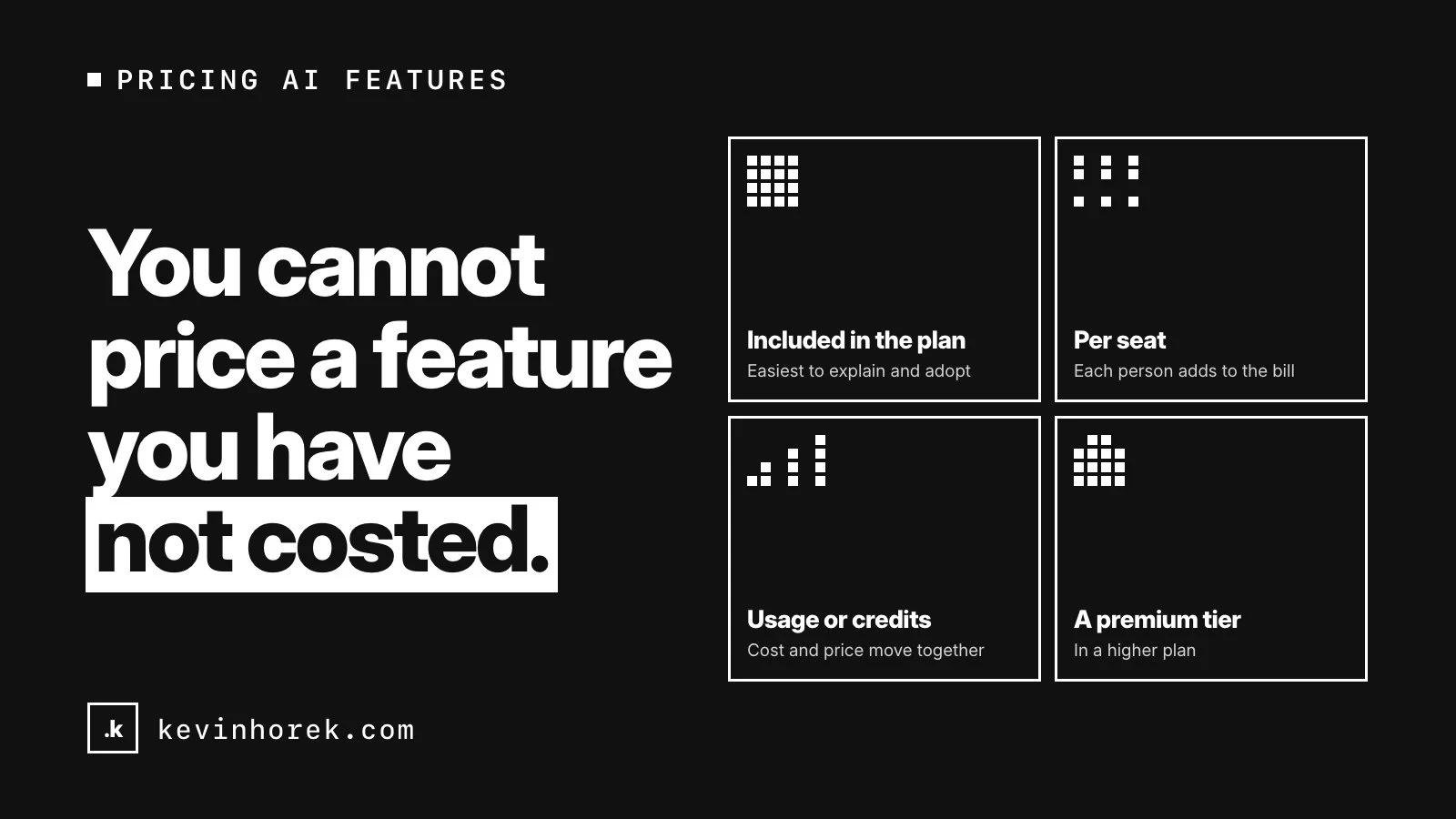
Once an AI feature works, someone asks how customers should pay for it. Include it in the plan? Charge per seat? Meter it? Put it in a higher tier?
Each answer can be right. Each one can also lose money, confuse customers or both, depending on how the feature is used and what it costs to run.
I don't have one model I recommend. I do have a way of deciding, and it starts before anyone discusses a number.
Start with what it costs to run
You cannot price a feature you have not costed. In what an AI feature costs to operate, I argued for working out the cost per successful result, as a range, including retries, review and support. That number, and how much it varies between customers, does most of the work.
The key question is the spread. If light and heavy users cost about the same to serve, a flat price is simple and safe. If your heaviest customers cost many times what your lightest ones do, a flat price means light users subsidize heavy ones, and the heavy users are often your most engaged.
The four common models
Included in the plan. The feature is part of what customers already pay for. It is the easiest to explain and the easiest to adopt, because nobody has to think before using it. It fits when the cost per customer is low and predictable, or when the feature mostly makes the existing product better rather than doing new work. The risk is that heavy use eats your margin and nothing in the price tells you.
Per seat. Each person who gets the feature adds to the bill. This fits when value and cost both track the number of people using it, like an assistant each person uses through the day. It breaks down when a few users do most of the work, or when the AI does work no seat is attached to, like processing incoming documents overnight.
Usage or credits. Customers pay for what they use, or buy a pool of credits that different actions draw down. Cost and price move together, which protects you. The trade-off is that customers now have to think before they click, and some will hold back on the very feature you want them to use. Credits help when actions vary a lot in cost, because one unit can stand for many kinds of work.
A premium tier. The AI features sit in a higher plan. This works when the feature is clearly worth more to a certain kind of customer, and it keeps the entry plan simple. The risk is that the customers who would get the most out of it never see it.
Real products often mix these. Notion's pricing page offers a trial of Notion AI on its lower plans, includes it in Business and Enterprise, and uses credits for custom agents. GitHub gives paid Copilot plans a monthly allowance of premium requests, and each model has a multiplier that sets how fast it uses that allowance. Intercom prices its Fin AI agent per outcome and spells out what counts as one. I mention them to show the shapes, not to say any of them is right for you.
Make usage visible
Whatever you choose, customers should be able to see what they have used and what is left before it becomes a problem.
That means:
- a usage view an admin can find without contacting support;
- a warning before a limit, not only at it;
- plain wording about what one unit of usage is;
- for credits, what an action will cost, shown before it runs.
Visible usage helps you too. When customers can see what they spend, their choices show you which features they value.
Set limits, and design what happens at them
Even an included feature needs a limit, or a fair use policy that says in plain language what normal use looks like. Otherwise one automated integration or one runaway agent can cost more than the customer pays.
What happens at the limit is a product decision. The feature can stop with a clear message, slow down, move to a cheaper model, or keep going and bill the extra if the customer agreed to that in advance. GitHub's docs describe one version: once the allowance is used, people can keep using Copilot with its included models for the rest of the month, or set a budget for more premium requests. A feature that silently stops, or a surprise bill, is the outcome to avoid.
Plan for costs and models changing
AI costs don't stand still. Model prices change, newer models can do the same work for more or less, and providers retire older models. Anthropic, for example, gives at least 60 days' notice before retiring a publicly released model.
A few habits keep your pricing from breaking when that happens:
- Price the outcome, not the model. "Summaries per month" survives a model switch. A unit tied to one model's tokens does not.
- Keep some margin, so a pricier model or heavier use doesn't turn a feature unprofitable overnight.
- Decide now what you will do when costs fall: keep the margin, raise limits or lower the price. Raising limits can be the easiest to explain.
- Re-run the cost estimate whenever you switch models.
Test the price with real customers
Don't set the price in a meeting by guessing. Test it, like any other product decision, with the people who would pay.
Some ways to do that before you commit:
- Offer the feature to a small group of customers and watch what they use.
- Ask customers to choose between two concrete options, not whether they like the feature.
- Watch who hits the limits. They are either your best customers or a cost problem, and you need to know which.
- Keep the first version easy to change, and tell early customers the pricing may change.
It is the same principle as testing a product idea before building it: design an experiment that could change your mind.
Price the outcome customers value, at a level you can still afford when they use it heavily.
Questions to answer before you set the price
- What does one successful result cost, as a range?
- How different are your light and heavy customers?
- Does value track seats, usage or the kind of customer?
- What will customers see about their usage, and when?
- What happens at the limit?
- What changes if model costs rise or fall?
- Which customers will you test it with first?
If you are adding an AI feature and are not sure how to charge for it, email me. I am happy to work through the numbers and the options with you.