When someone asks me to build an AI agent, the first thing I ask is what it should do, step by step.
If the answer is a sequence that happens the same way nearly every time (read this, check that, send it to the right person), that is good news. A fixed sequence is easier to build, test, explain and afford than an agent. The trick is noticing which one you actually need.
I would rather build the simplest system that reliably completes the job than the most autonomous system I can demonstrate.
Two different things
Anthropic's guide to building effective agents draws a useful line. Workflows are systems where models and tools are orchestrated through predefined code paths. Agents are systems where the model directs its own process and decides how to use its tools.
The same guide recommends finding the simplest solution possible and only adding complexity when it is needed. It also notes that for many applications, a single well-built model call, with retrieval and good examples, is usually enough.
That matches how my own products are built. The AI usually sits in one or two carefully placed steps inside an otherwise ordinary process.
Start by writing down the steps
The quickest test is to write the process down. If you can list the steps in order, and they are the same for nearly every case, you have a workflow. The AI is a component inside it, not the thing in charge.
Mentor Intelligence is built this way. When a founder pitches, the steps are fixed: the pitch video is transcribed, a summarizer turns it into a list of needs, and staff edit that list before anything is saved. AI does two of the steps. The order never changes, and the model never writes to the database on its own.
That design is less dramatic in a demo than an agent deciding what to do next. It is far easier to trust.
Where fixed rules belong
Some things should not be left to a model's judgment:
- Permissions, and who is allowed to see what.
- Calculations, totals and anything involving money.
- Eligibility, deadlines and policy rules.
- Routing based on clear criteria.
- Formatting and validating data that goes into other systems.
Rules are cheap to run, easy to test and easy to explain. When a customer asks why something happened, "because the rule says so, and here is the rule" is a good answer. "Because the model decided" usually is not.
Where an AI step earns its place
AI is worth adding where the input is messy and a rule cannot cope: reading documents, understanding free text, classifying requests, drafting a reply, summarizing a long record, matching people to needs.
In Mentor Intelligence, for example, AI extracts a founder's needs from a pitch video or document and shows them to staff for editing. That is one flexible step in a fixed flow. The model handles the messy part. People and code handle the rest.
When an agent actually makes sense
Agents have a real place. The Anthropic guide describes them as suited to open-ended problems where it is hard or impossible to predict the number of steps, and where you have some level of trust in the model's decision-making. Writing and changing code is a good example, and I build most of my own software with coding agents.
The guide is also clear about the costs. Agentic systems often trade latency and cost for better task performance, and their autonomy brings higher costs and the potential for compounding errors. It recommends extensive testing in sandboxed environments with appropriate guardrails, checkpoints where the agent can pause for human feedback, and stopping conditions such as a maximum number of iterations.
Those are not small additions. Each one is work to design, build and maintain.
How much freedom does the task need?
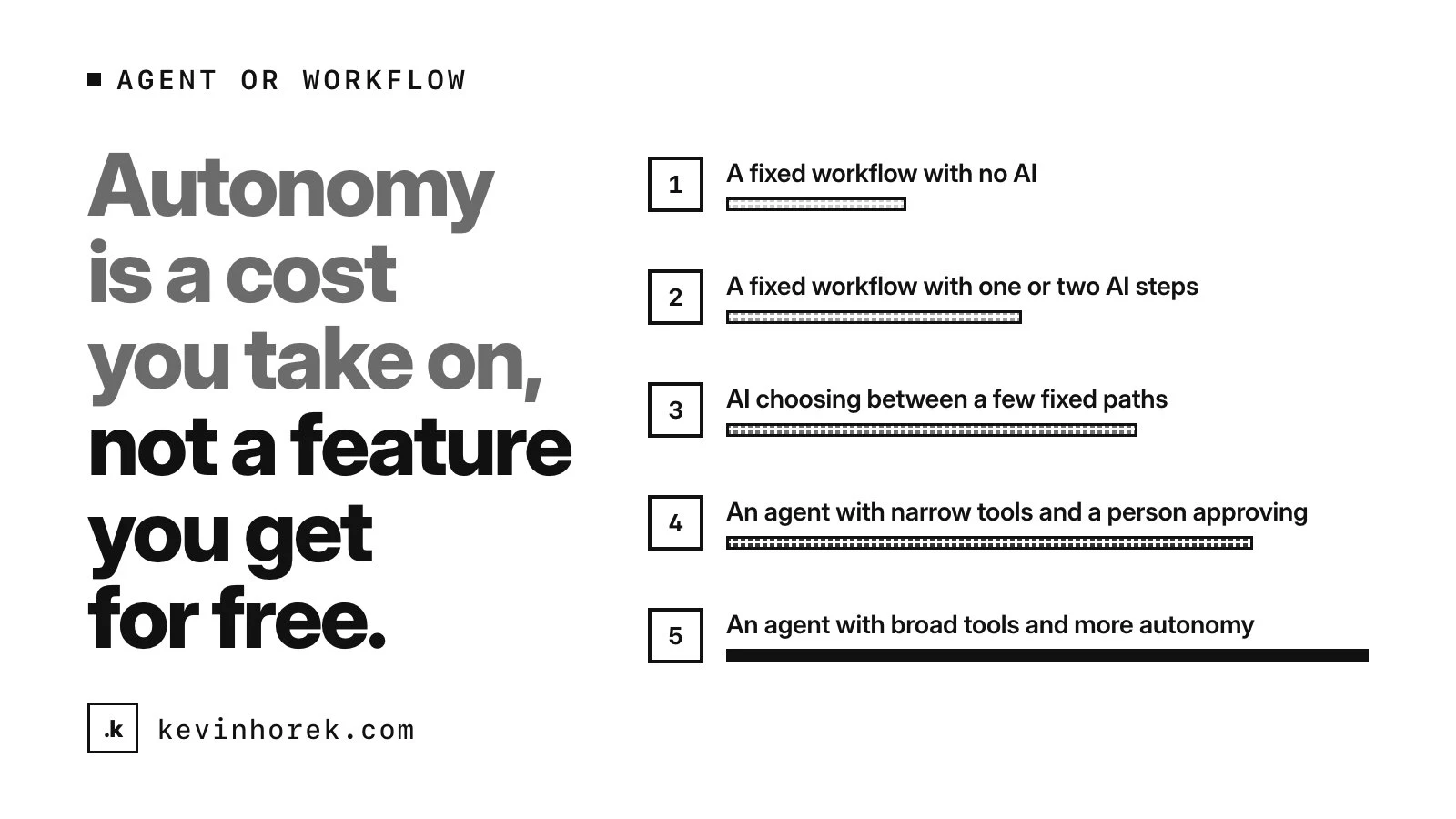
I think of it as a ladder, and I only climb a rung when the one below fails on real cases:
- A fixed workflow with no AI.
- A fixed workflow with one or two AI steps.
- AI choosing between a few fixed paths.
- An agent with a small set of narrow tools, and a person approving anything that matters.
- An agent with broad tools and more autonomy.
Many products never need to go past the second or third rung. Some genuinely need the fourth. The fifth needs serious evaluation and review behind it, and a good reason to be there.
The maintenance you are signing up for
Freedom has a running cost. An agent needs evaluations, monitoring, someone reading transcripts when things go wrong, carefully designed permissions and limits on what it can spend. A workflow needs ordinary tests and ordinary logs.
Before choosing, I ask who will read the logs when it fails, how they will know why it failed, and how much review time the team is really willing to give it every week. Those answers often decide the architecture more than the model does. They also decide what the feature costs to operate.
Autonomy is a cost you take on, not a feature you get for free.
The questions I ask first
- Can we write the steps down in order? If yes, start with a workflow.
- Which steps involve messy input that a rule cannot handle?
- Which decisions must stay with code or with a person?
- What happens when the AI step is wrong, and who notices?
- How much review and maintenance will the team actually sustain?
If you have been asked to build an agent and suspect a workflow would do, email me at kevin@kevinhorek.com and I will tell you which I think it is.