I volunteer as a mentor in a university venture mentoring program. I am one of a small team of mentors working with one founder company.
I also built Mentor Intelligence, because programs like this one match mentors to founders from memory and spreadsheets.
But a good match is only the start. What matters after that is whether the mentor is useful once they are in the room. Here is what I try to do, and what I look for in the mentors around me.
Questions before advice
Founders do not run short of advice. Almost everyone they meet has an opinion. What is rarer is someone who asks good questions and listens to the answers before offering one.
So I start with questions:
- What are you trying to decide right now?
- What have you already tried, and what happened?
- Who is the customer, and how do you know?
- What would change your mind?
The answers often show that the question the founder brought is not the one that matters most. A founder asking about a marketing plan may really be unsure who the customer is. Advice on the first question is wasted until the second one has an answer.
Advice that arrives before the questions is often advice about the mentor's own last company. It can be true and still not fit. It is the same habit I bring to product work, where I want the situation explained before we discuss features.
Ask to see the real thing
A pitch is the official version of a company. It is tidy and persuasive, and it is meant to be. Useful mentoring needs the real version.
So I ask to see three things:
- The product. Used live, not shown in slides. Where does it break? What gets skipped in the demo?
- The numbers. Whatever the founder tracks: users, revenue, costs, runway. And what they do not track yet, which matters just as much.
- The customer evidence. Interview notes, emails, sign-ups, and the people who said no and why.
This is not an audit. The point is that advice based on what a founder can show is better than advice based on what they hope. It is the mentoring version of discovery calls and walk-throughs: the official version tells you what the work is supposed to be, and seeing the real thing tells you where it breaks.
If there is little customer evidence yet, that is not a failure. It is usually the most useful thing to work on next.
Be clear about your own strengths
Programs often ask mentors for their "superpowers." It can feel like an awkward question. I think it is one of the most useful things a program asks, as long as mentors answer it honestly and narrowly.
"Business" is not a superpower. Neither is "startups." A useful answer is specific enough that program staff, and the founder, know when to come to you and when not to.
After more than 30 years and 50+ shipped platforms, mine are product, UX and AI: turning an idea into a first version people can use, testing it with real users, and deciding what to build next. I have also sold a startup, so I can speak to that from experience. I am not a lawyer or an accountant, and I say so.
Specific answers also make good matching possible. Staff can only place a mentor well if they know what that mentor is actually good at. A vague answer makes a mentor hard to place, and easy to place badly.
Three mentors with different skills
Programs like this one often put a team of three mentors with each founder. That is a good model, but only if the three bring different things.
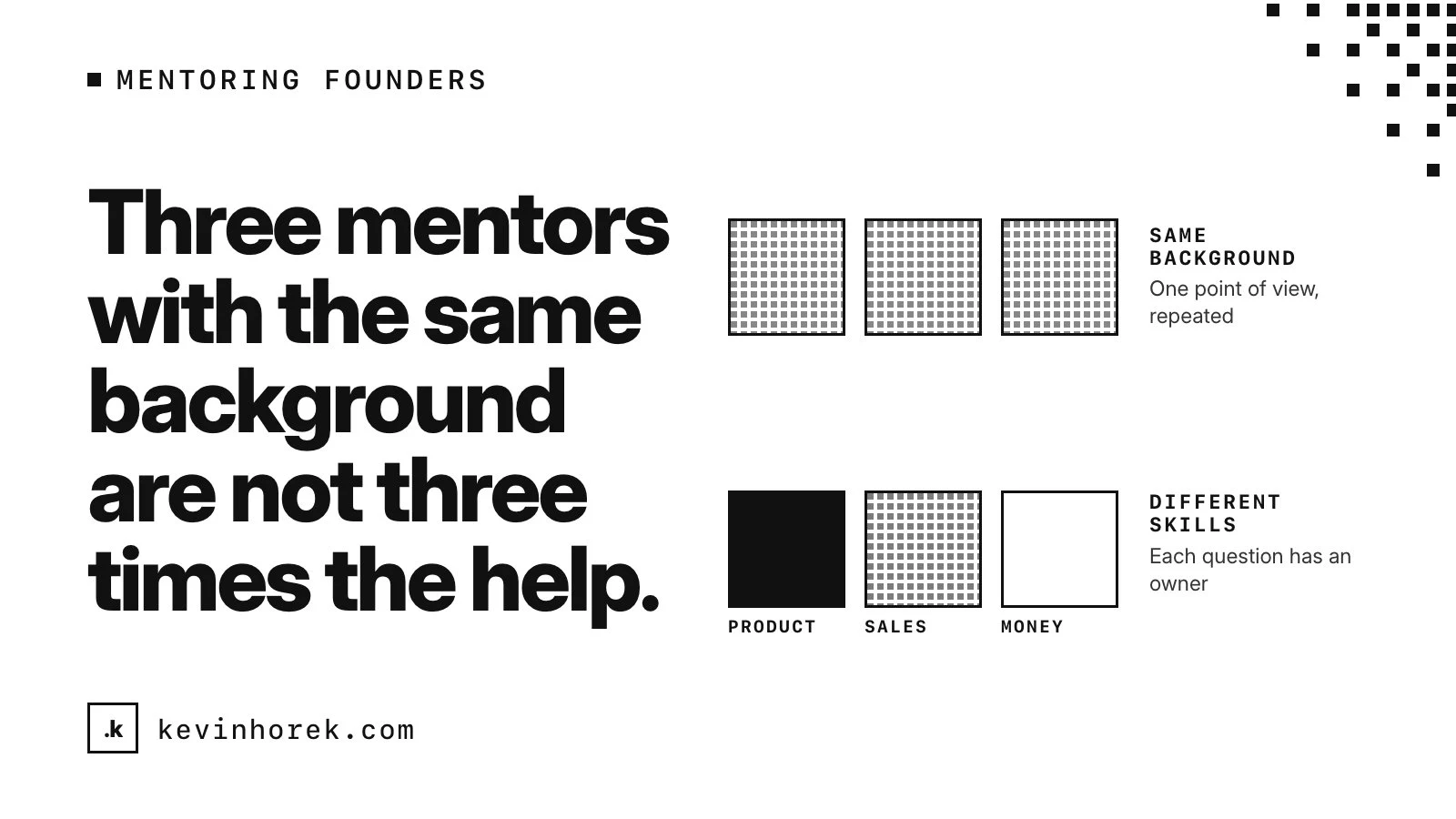
Three mentors with the same background are not three times the help. They are one point of view, repeated. A founder with a product question, a sales question and a money question gets more from three people who each own one of those than from three who all know the same one well.
Different mentors will also disagree sometimes. I think that is healthy. A founder who hears two reasoned views and has to choose between them is doing the founder's job. A team that always agrees may just be a team with the same blind spot.
For program staff, that means building each team on purpose. Start from the founder's real questions, not just the one they arrived with, and check that each question has a mentor who owns it. If two mentors cover the same ground and nobody covers money or sales, the team is not balanced yet, however strong each person is.
Know when to say "I'm not the right person for this"
This may be the most useful sentence a mentor has.
When the founder's real problem sits outside your strengths, say so early. Then help them find who is right: another mentor on the team, program staff, or someone in the wider network.
Staying in the room past your strengths has a cost. Founder time is short, and confident advice from the wrong person can send a company in the wrong direction. Saying it plainly is not a weakness. It lets the program bring in someone better suited, and an open seat on a team is something staff can fill.
It works the other way too. If I am not adding much to the problem a founder has right now, I would rather say so than keep a seat out of habit.
What I try to leave behind
A good session does not end with ten pieces of advice. It ends with one or two decisions the founder owns and a clear next step, ideally one that produces evidence: a customer conversation, a small test, a number to watch.
Ask first, look at the real thing, be honest about what you know, and step aside when someone else knows it better.
If you mentor founders, or run a program that matches mentors with them, email me. I would like to hear what works in yours.