If you advise several companies at once, your calendar is full of check-ins. Most tools are good at that part. They know when the meeting is, who is coming and where the call link is.
What they do not know is what you promised in the last one.
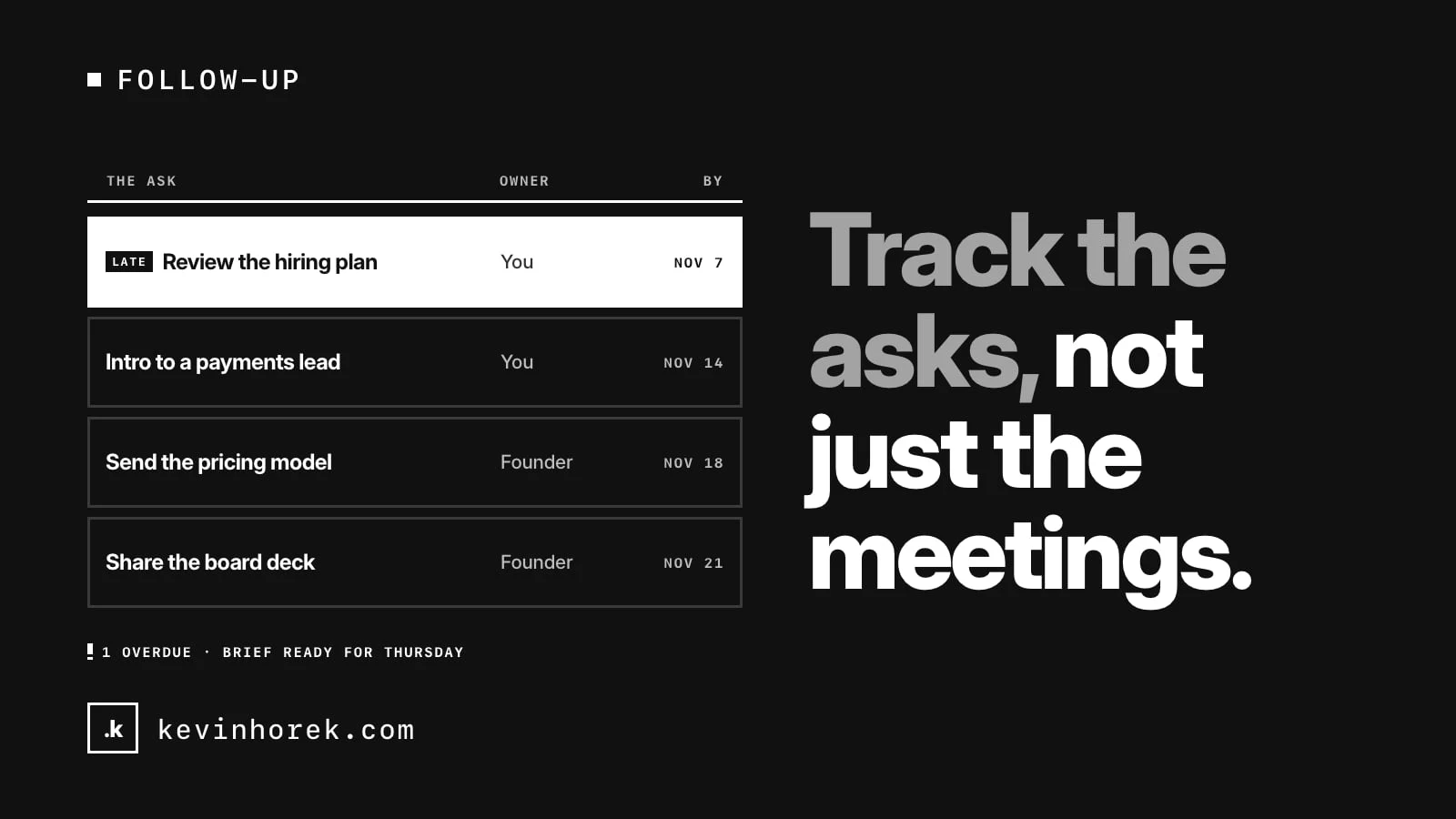
An intro to a possible hire. A review of the pricing page. A look at the board deck before it goes out. The founder promised things too: send the numbers, talk to the customer who churned, try the change you suggested. Two weeks later, those promises are scattered across notes, email threads and memory.
The meeting happened. The value was in the asks, and nobody tracked them.
My advice to advisors, fractional execs and anyone with a lot of recurring meetings: track the asks, not just the meetings.
What counts as an ask
An ask is anything someone said they would do. I would keep it that simple. It has four parts:
- What: the thing itself, in one line.
- Who owns it: you, the founder, or someone else on the team.
- By when: a date, even a rough one.
- For which company: if you advise more than one.
Without an owner, an ask is a wish. Without a date, it is a someday. Most asks that slip were missing one of those two.
Capture asks during the meeting, not after
The best time to write down an ask is the moment it is made. Say it back out loud: "So I'll send you two names for the head of sales by Friday." It takes five seconds, it confirms you heard it right, and it gives the founder a chance to correct it.
Then write it down in one place. Not in the notes for that meeting, where it will be buried, but in a list of open asks you can see across every company.
At the end of the meeting, read the asks back. Both sides leave knowing what they owe.
Show what is slipping
A list of open asks is useful. A list that shows which ones are late is more useful.
Sort asks by date and mark the ones that are overdue. Show yours separately from the founder's, because you can only fix your own. If you advise several companies, look across all of them once a week. It is easy to keep promises to the company you talk to most and let the others slide.
A short weekly reminder of your overdue asks does more than any notification during the day.
Walk into every check-in prepared
The second half of this habit is the brief. Before each check-in, spend five minutes on four questions:
- What changed since the last meeting?
- Which asks are still open, on both sides?
- What is worth raising this time?
- What could I offer: an intro, a review, a piece of advice?
If you have access to the company's numbers, look at what moved. If not, read the last notes. Either way, the first ten minutes of the meeting should not be you catching up.
AI can help draft this brief from the notes and any data the founder shares with you. I would treat that draft as a starting point and check it before the meeting. A brief that gets a number wrong is worse than no brief. And whatever data a founder shares, they should be the one who decides what you can see.
Look for intros across your companies
Advisors with several companies often have the most useful intro sitting in their own portfolio. One company needs a design partner. Another has just finished the same problem. One is hiring a role another just filled well.
Those matches are easy to miss because each company lives in its own notes. Once a week, look at the open needs across all of them and ask whether any of your other companies could help. When you find one, ask both sides before you introduce them. A double opt-in intro protects everyone's time.
Keep the system light
The trap with any tracker is that it becomes the work. If logging an ask takes longer than doing it, people stop logging.
So keep it small:
- one list of open asks across every company;
- one line per ask, with an owner and a date;
- a weekly look at what is overdue;
- a short brief before each meeting.
That is enough. I wrote about how I work with founders in mentoring founders, and about what the role involves in what a fractional product and AI lead does. In both, the meetings are the easy part. Following up is where advice turns into results.
A meeting is only as useful as the follow-up. Track what was promised, who owns it and when it is due.
Try it
I built a rough prototype of this idea, Advisor OS, a workspace for advisors with several companies. Each company page has an ask tracker, there is a drafted brief before each check-in with the open asks and suggested topics, and a weekly digest suggests intros between companies. Try the demo. It runs on made-up companies and data, and nothing is sent.
A checklist for tracking asks
- Write every ask with what, who owns it, a date and the company.
- Say asks back out loud during the meeting, and read them back at the end.
- Keep one list of open asks across every company.
- Show what is overdue, and separate yours from theirs.
- Prepare a short brief before every check-in.
- Look for intros across your companies once a week, and ask both sides first.
- Keep the system small enough that you actually use it.
How do you keep track of what you promised in meetings today? A notebook, a task app, your inbox, or memory?
If you have a system that works, or one that keeps failing, email me.
#Advising #Workflow #Productivity