Sometimes the most useful thing you can do as a product person is notice that an existing tool answers the wrong question.
Alarm clocks are a good example. They ask when you want to wake up. But a sports parent with a 10:00 AM game, a traveler with a 2:00 PM flight or a commuter with a fixed train does not really care when they wake up. They care when they need to start.
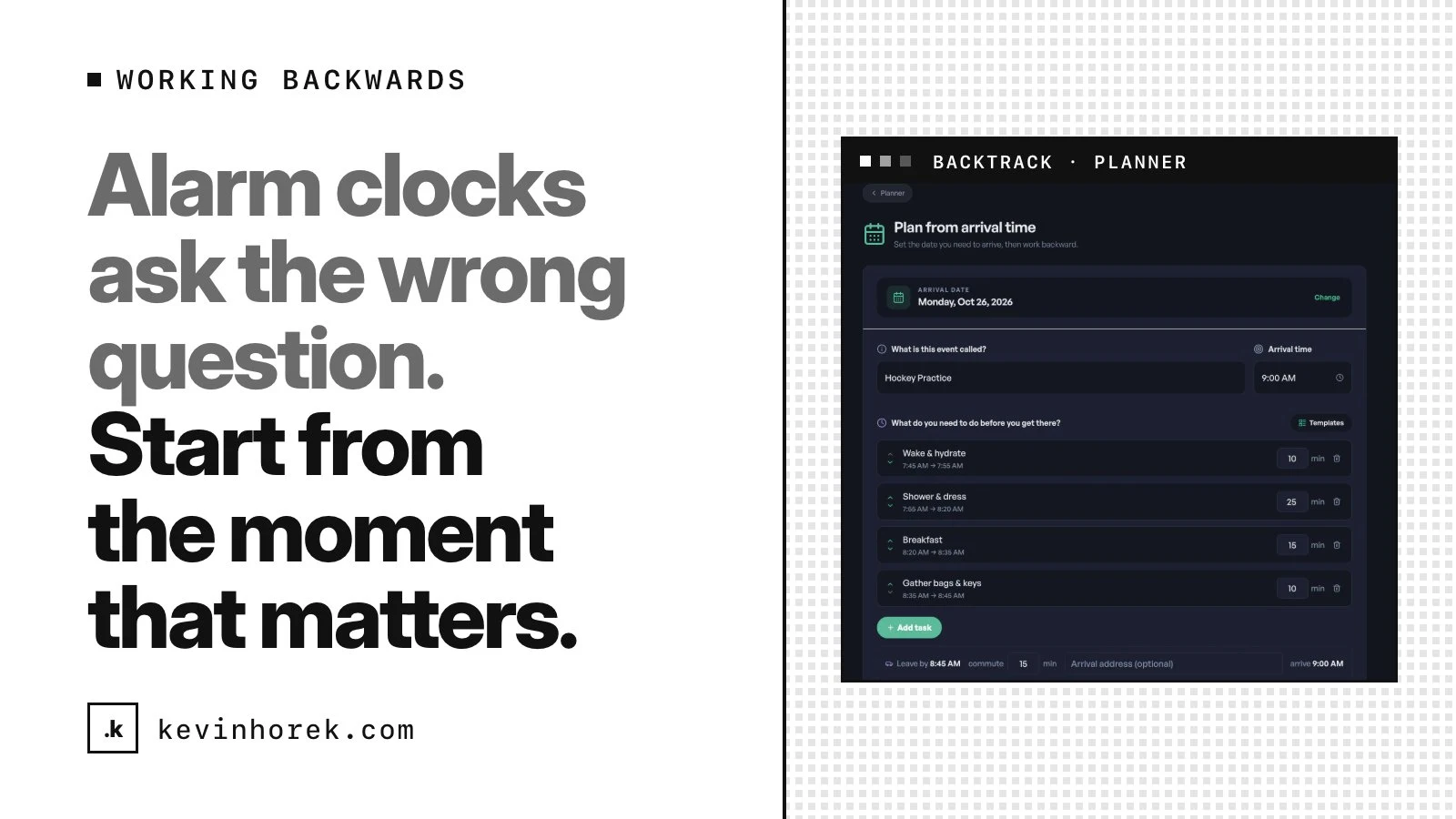
That small shift is the whole idea behind BackTrack, a reverse alarm clock. You set when you need to arrive, and it works backwards through your routine and commute to tell you when to start.
Here is the product thinking behind it, and how you can use the same approach on your own product.
Find the moment that actually matters
Every routine has a moment that matters. For a flight, it is the departure. For a game, it is the warm-up. For a dinner reservation, it is the time on the booking.
Everything before that moment is in service of it: getting ready, packing the car, buffers for traffic, the drive itself. People do that math in their heads all the time, usually under pressure, and usually a little wrong.
BackTrack starts from that moment and works backwards. Each task gets its own start and end, counted back from the arrival time. Then the commute gives a leave-by time, and the app shows the moment to begin, recalculated as tasks and the commute change.
What to take from this: look for the moment your users really care about, then trace backwards to everything that has to happen before it. Often the product is in removing that mental math.
Name the category, even if people have to learn it
BackTrack sits between alarms, habit trackers and calendars, and it could easily be mistaken for any of them. I had to choose between calling it a smarter alarm or naming a new category.
I went with a new category: an arrival-time planner. The copy, the onboarding and the templates all start from the arrival, never from the wake-up.
That is a category people have to learn, and the tagline has to carry it: know exactly when to start. But calling it a smarter alarm would have pulled people's expectations toward the thing it replaces.
What to take from this: if your product changes the question, do not describe it in the language of the old answer. Pick words that put people in the new frame from the first screen.
Build for where the moment happens
BackTrack has to work on a phone at 6 AM and on a watch in a parking lot. That pushed me toward one shared codebase instead of native apps per platform.
It is built with Expo for iOS, Android and the web from one codebase, with Apple Watch and Wear OS companions and home-screen widgets on the way.
There are fewer platform-specific flourishes. In return, there is far less to maintain alone, and every improvement reaches every device at once.
What to take from this: picture the exact place and moment people will use your product, and let that decide your platforms. A shared codebase is often the right call for a small team, as long as it serves those moments well.
Let AI use your logic instead of guessing
BackTrack has an MCP server, which lets AI assistants use its calculator to answer the leave-by question.
That matters because a general assistant asked "when should I leave for a 2:00 PM flight?" will guess. With BackTrack's math available, it can answer using the person's actual tasks and buffers.
AI also helped behind the scenes: the spec and design system were drafted with AI assistance.
What to take from this: if your product has a precise calculation at its core, consider exposing it to AI assistants instead of letting them improvise an answer.
The best questions start from the moment that matters, not from the tool you already have.
Working backwards as a habit
The approach behind BackTrack works well beyond scheduling. A few questions I ask on almost every product:
- What is the moment the user really cares about?
- What do they currently have to work out in their head to get there?
- Which existing tool are they using, and what question does it answer instead?
- What would the product look like if it started from the right question?
Most of the time, the answer is not a bigger feature set. It is a better starting point.
BackTrack is live as a web app, with iOS and Android builds through Expo and wearable companions next. If you are building a consumer product and want to find the question it should really be answering, email me.