The riskiest way to launch an AI workflow is to switch it on and let it act. One day the office does things by hand. The next, an AI is texting customers, booking jobs or sending requests to insurers.
If something goes wrong on that first day, it goes wrong with real customers, and nobody knows how often it would have gone wrong before.
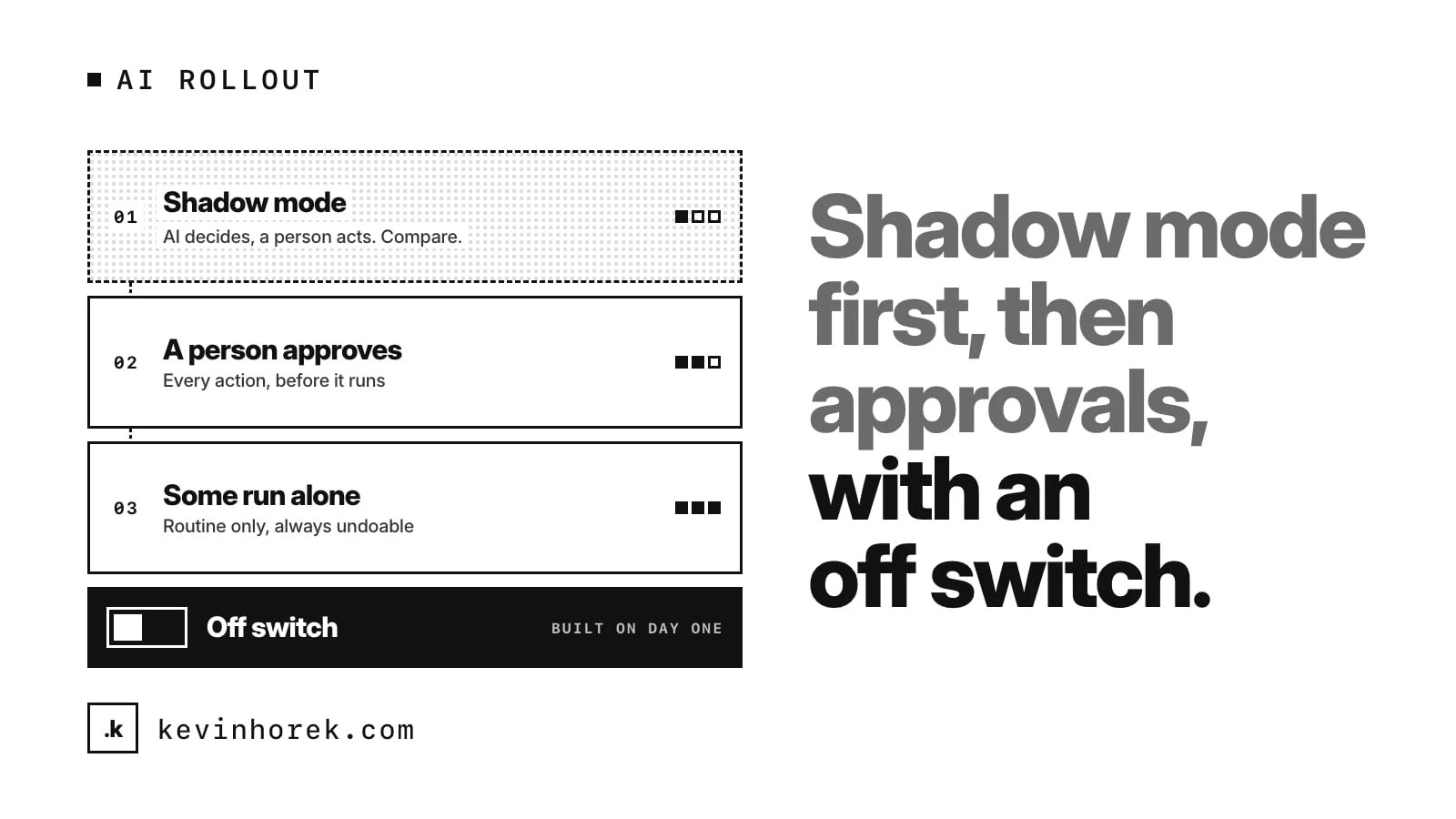
My advice: roll it out in stages. First, run it in shadow mode, where it does the work but nothing leaves the building. Then let it act, but only after a person approves each action. And build the off switch on day one, before you need it.
Stage one: shadow mode
In shadow mode, the AI runs on real work alongside your team. It reads the same calls, messages or schedules. It makes the same decisions it would make in production. But nothing it produces reaches a customer or another system. Your team keeps doing the job the way they always have.
Then you compare. For each case:
- What did the AI decide?
- What did the person decide?
- Where they differed, who was right?
This is the cheapest test you will ever run. You are using real work, so the cases are realistic. And because nothing is sent, mistakes cost nothing except the time to review them.
I would run shadow mode for at least a few weeks, long enough to see a normal week, a busy week and some unusual cases. Read a sample of decisions every day at first, then every few days.
What shadow mode tells you
You are looking for patterns, not perfection.
- Where it is reliably right. These are candidates to move forward.
- Where it is reliably wrong. These need better rules, better data, or a person.
- Where it is unsure. A good system should say when it doesn't know. If its confidence doesn't match how often it is right, you can't use confidence to decide what needs a person.
- What it never sees. Some cases may not show up in a few weeks. Write them down and test them on purpose.
Shadow mode also tells you whether the workflow is worth it. If the AI only agrees with your team on the easy cases, it may not save much. That is worth knowing before you build the rest.
Stage two: a person approves each action
Once shadow mode looks good, let the AI act, but only with a person's approval.
The AI drafts the text, the booking, the dispatch or the request. A person sees exactly what will happen, then approves, edits or rejects it. The AI does the work of preparing. The person keeps the decision.
The approval screen matters. It should show the full action, the reasons behind it and anything the AI was unsure about. "Approve?" with no detail is not a review. I wrote about this in where an AI agent should ask for human approval.
Track every approval, edit and rejection. Edits are the most useful data you have. They show exactly where the AI's draft differed from what a person wanted.
Stage three: let some actions run on their own
Only after a long run of approvals should you let any action go through without a person. And only for the narrow cases where the record is clear.
I would set rules like these:
- Only certain action types can run on their own, such as confirming a routine booking.
- Only above a confidence level you chose from the shadow-mode results.
- Never for anything involving money, safety, health or legal commitments.
- Always with an easy way for a person to undo it.
Some actions should never move to this stage. That's fine. I keep a list of what I would refuse to automate for exactly that reason.
Build the off switch on day one
Every AI workflow needs a pause button, and it should exist before launch, not after the first incident.
When someone presses it:
- the AI stops drafting and sending immediately;
- new work goes to a fallback, such as the office inbox, an answering service or a manual queue;
- the pause is logged, with who pressed it and when;
- nothing is lost, and the team can pick up by hand.
Test the off switch before launch. Make sure the people who need it know where it is and that they are allowed to use it without asking anyone.
Keep a record of everything
At every stage, log what the AI proposed, what a person decided, what actually happened and any rule changes. When something goes wrong, you want to answer "why did it do that?" in minutes, not days.
The same log is how you decide when to move to the next stage. You are not guessing. You are reading the record.
The short version
- Run in shadow mode on real work, with nothing sent.
- Compare its decisions with your team's, and read the differences.
- Let it act only with a person's approval of each action.
- Move narrow, low-risk actions to run on their own only when the record supports it.
- Build and test the off switch before launch.
- Log every proposal, decision and rule change.
I built rough prototypes of this rollout for six small-business workflows. The Insurance Verification Copilot has a shadow mode that flags coverage gaps but drafts nothing, and Morning Ops waits for a dispatcher to approve the day's routes before any customer gets a text. Try the insurance demo or the morning planner. Both run on demo data and send nothing.
How are you rolling out AI in your business today: all at once, or in stages? If you have a rollout story, good or bad, email me.
#AI #AIAgents #Operations #Rollout