On October 31, 2026, Figma described Weave as a way to connect AI generation and editing tools into reusable creative workflows. Its examples include sequences for creating and editing images or video, with tools for reviewing or rewriting prompts.
What interests me is the shift from producing an output to shaping a process.
Getting a useful result once is valuable. Knowing how to reproduce it, review it and adapt it for the next assignment is a different level of useful. That is where I would focus when deciding whether an AI tool belongs in a business workflow.
The prompt is not the whole process
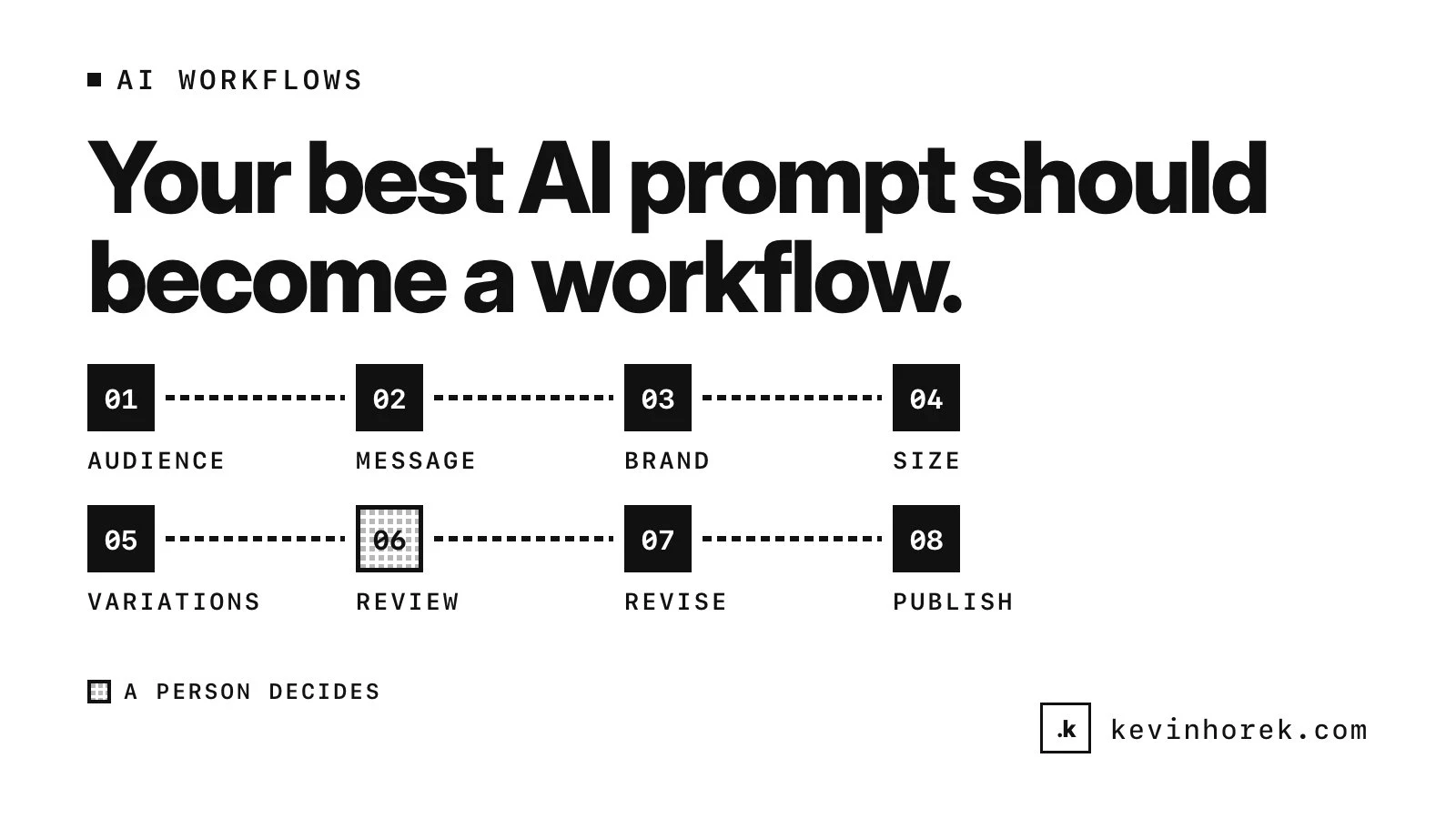
Imagine creating a set of promotional assets for a product launch. The visible generation step might be "create an image." But the actual assignment includes more:
- Understand the audience.
- Identify the message.
- Apply the brand direction.
- Choose the right dimensions.
- Generate alternatives.
- Review the result.
- Make revisions.
- Prepare the approved assets for publication.
A strong prompt may help with one part of that sequence. It does not organize the rest.
I would rather make those stages explicit than bury them inside one long instruction.
Reusability starts with separating what changes
For a recurring creative task, I would divide the inputs into three groups:
- Stable guidance: brand rules, accessibility expectations, terminology and constraints.
- Assignment-specific information: the audience, offer, subject, channel and desired action.
- Judgment: which option to choose, what needs revision and whether the result is ready to publish.
That separation makes the process easier to inspect.
If the message changes, you should not need to rebuild the brand rules. If the visual direction is wrong, you should be able to revise that stage without losing the approved copy. This is the kind of structure I would want a reusable workflow to support.
Add review where the decision matters
I would not read a connected workflow as a reason to automate every stage.
It might be reasonable to generate several variations automatically, while choosing the final asset still needs a person to review accuracy, brand fit and suitability.
The review needs a clear purpose. "Check the output" is vague. "Confirm that the product is shown accurately and the message matches the approved offer" gives the reviewer a defined responsibility.
The goal is not the fewest possible clicks. It is a process with decisions people can understand. I take the same view of software releases, where humans keep launch authority.
Measure the complete job
A workflow that produces assets quickly but leaves a lot of cleanup may not be the improvement it first appears to be.
For an initial evaluation, I would record:
- Time spent preparing inputs.
- Number of regeneration and revision cycles.
- Review effort.
- Reasons outputs were rejected.
- Time needed to get the accepted result ready to use.
I would also test whether someone other than the person who built the workflow can run it successfully. That is the difference between a personal technique and a reusable team process.
Turn useful experiments into operating knowledge
Not every creative task should become a rigid template. Exploration needs room.
But when a task repeats, I would rather keep a clear process than depend on someone remembering the prompt that worked last month.
Weave is one example of tools moving in that direction, with its emphasis on connected, reusable sequences rather than isolated generations. The broader opportunity is to turn successful experiments into processes people can understand, challenge and improve.
The most valuable thing you save may not be the prompt. It may be the reasoning around when to use it, what to give it and how to decide whether the result is good enough.
If your team has a few prompts that work and nobody has written down the process around them, email me.