Launching OS
Tell a founder what to do next, what evidence they are missing, and how to become more fundable.
The problem
Early-stage founders keep their company in decks, documents and their heads. When a mentor program or an investor asks how ready they are, there is no evidence-backed answer and no clear next step.
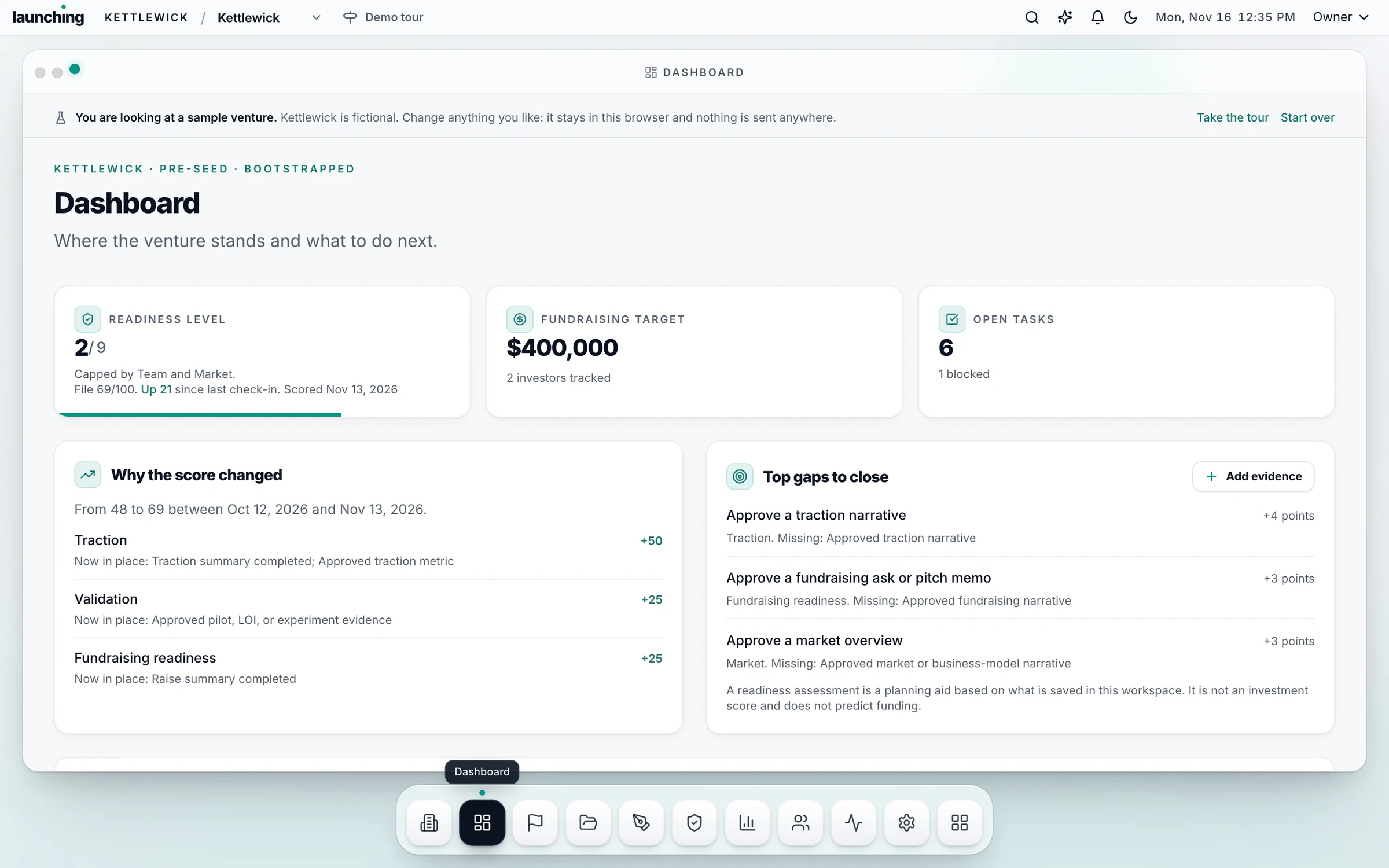
Launching OS gives the founder a private workspace: a venture profile, a launch plan of milestones and tasks, an evidence vault, a narrative studio, a fundability assessment scored by dimension, and an investor target list.
Key decisions
Advice from a model is only useful to a founder if the reasoning is visible.
A free-form chat, or structured outputs grounded in the workspace.
A copilot that drafts and analyzes only from workspace context, with a deterministic fallback when no model is available, so every recommendation shows the evidence it rests on.
Less magic in the demo. More trust from the person whose company it is.
Founders arrive by referral from mentor programs, and those programs promise that only their own team sees an application.
Shared accounts, an API sync, or link-out only.
Link-out only between Launching OS, Mentor Intelligence and the founder tools. A referral is an email the staff member sends; nothing moves without the founder’s own action.
No automatic hand-off. In return, a privacy promise that program staff can repeat word for word.
The work



How it was built
- 01DiscoverCalls and walk-throughs with the people who would use it
- 02CompileTranscripts, files and constraints in one requirements brief
- 03SpecifyA detailed, sourced spec from Perplexity, reviewed and locked
- 04BuildDesigned and built with the latest AI models, in the production stack
- 05TestUser testing on every preview, with real users on real tasks
- 06IterateFindings turned into the next round of changes, worst problems first
- 07ShipTests, security review and release, then back to testing and iterating↻ Back to Test
Where AI was used
Copilot drafting and analysis through an OpenAI-compatible API, grounded in the workspace; a deterministic fallback keeps the product usable with no model at all.
What’s next
Integration-ready links to Global Funding Studio, so an onboarded venture gets investor and program suggestions with reasons.